
Last updated November 17, 2026
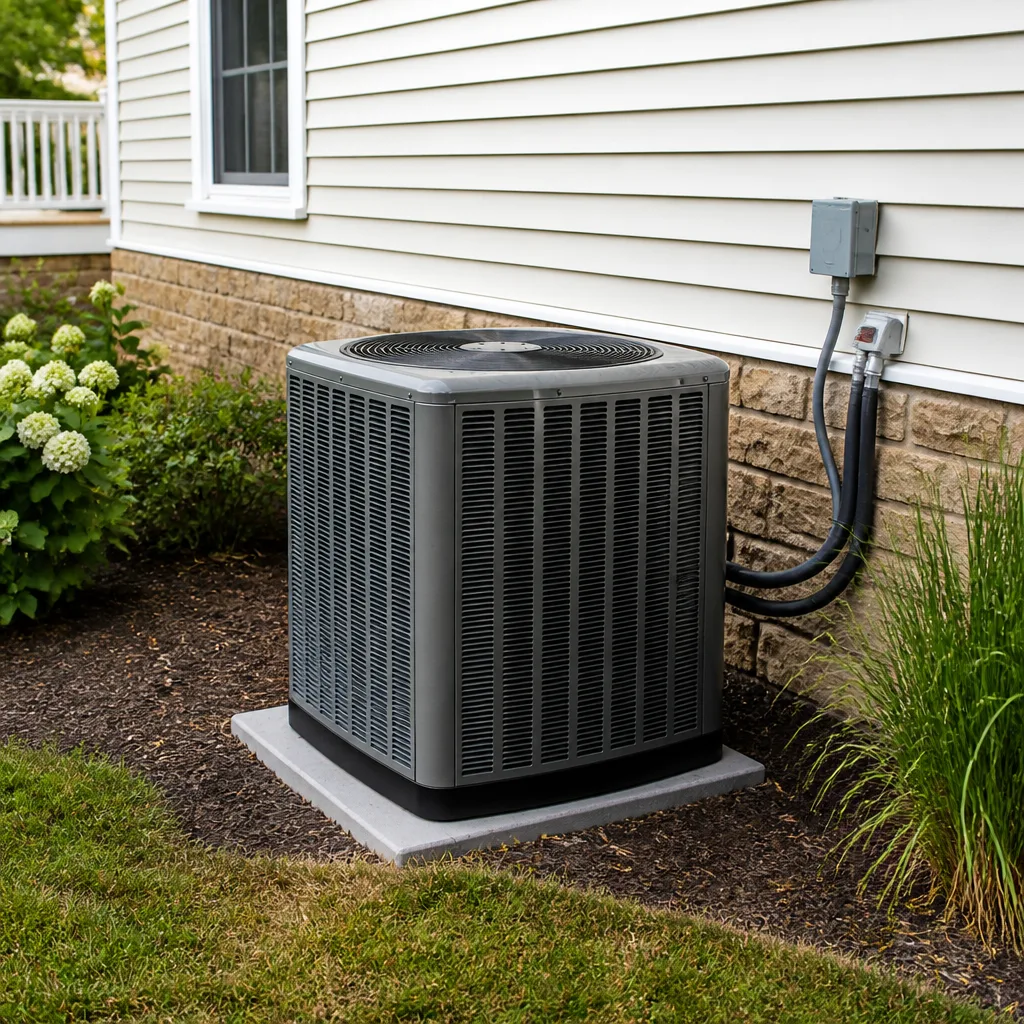 AC repair
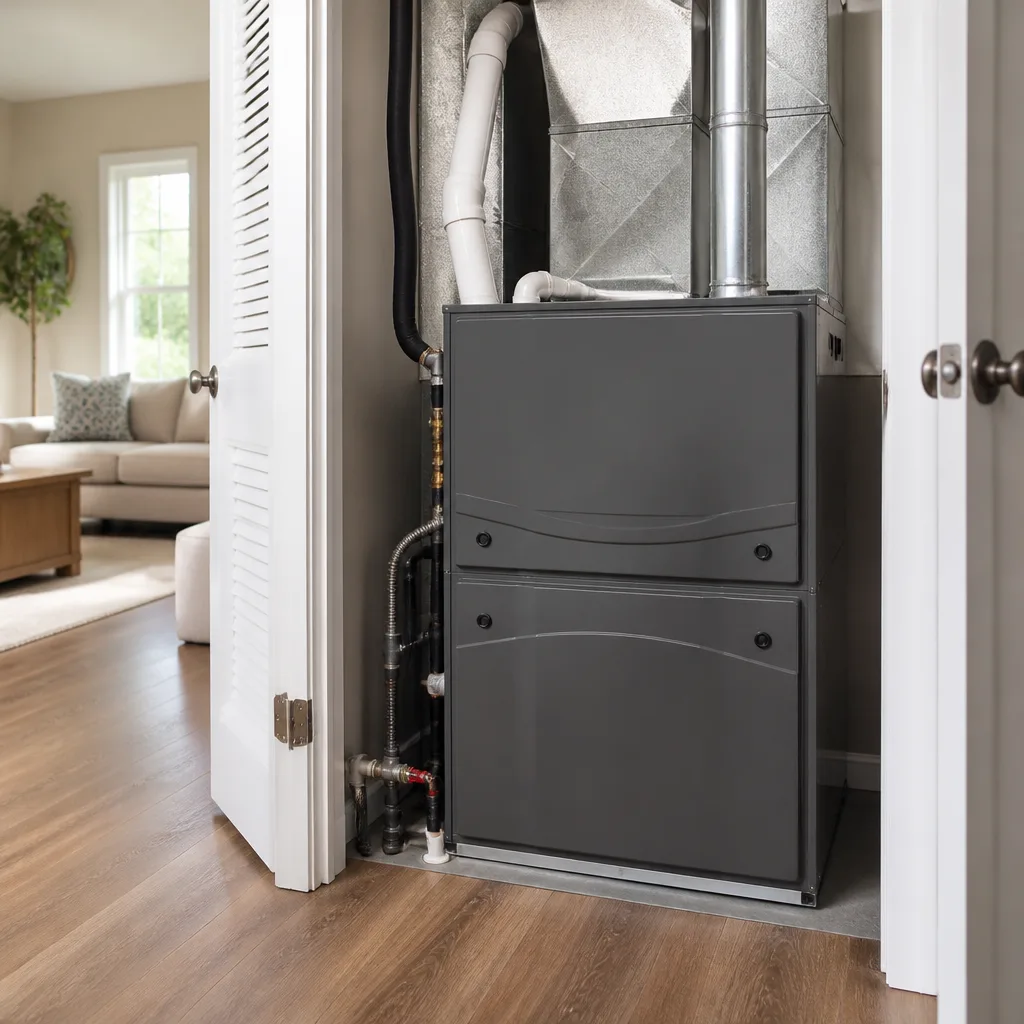 Furnace & heating
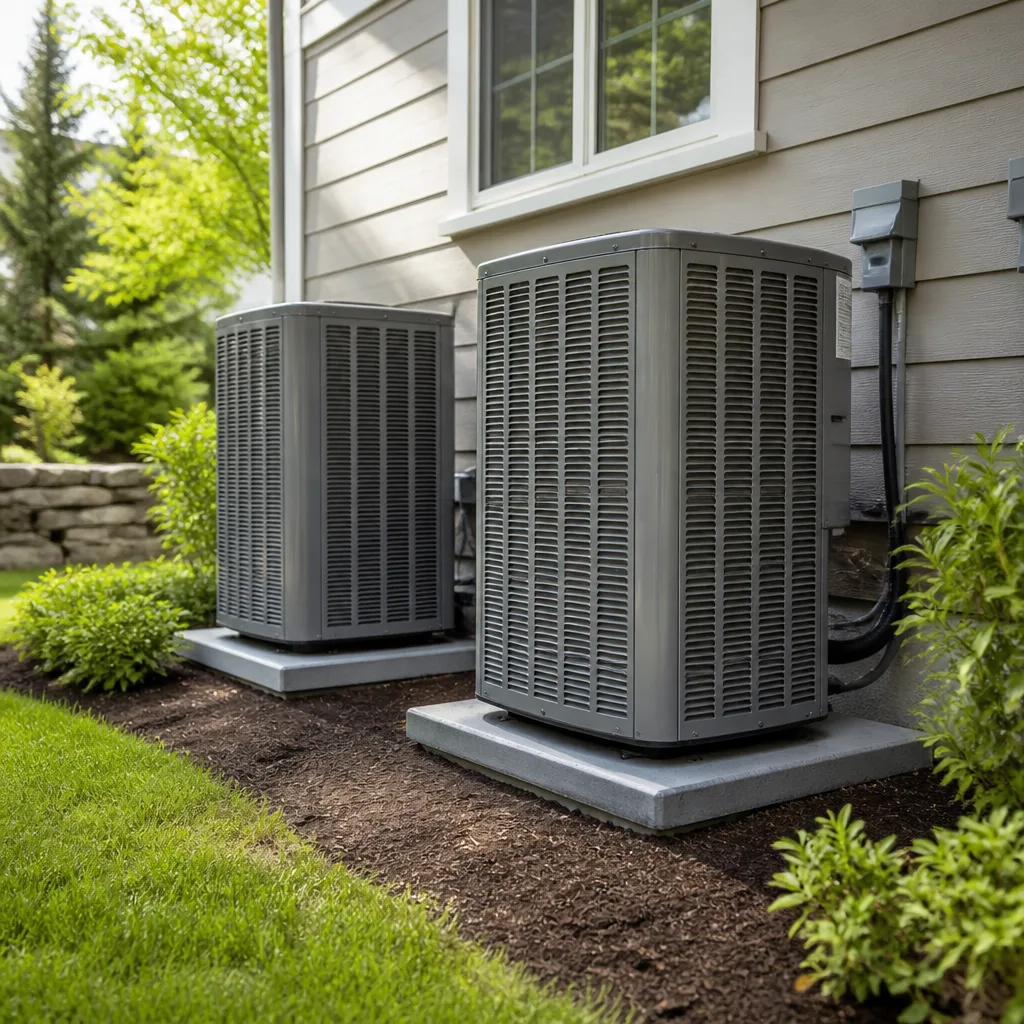 Heat pumps
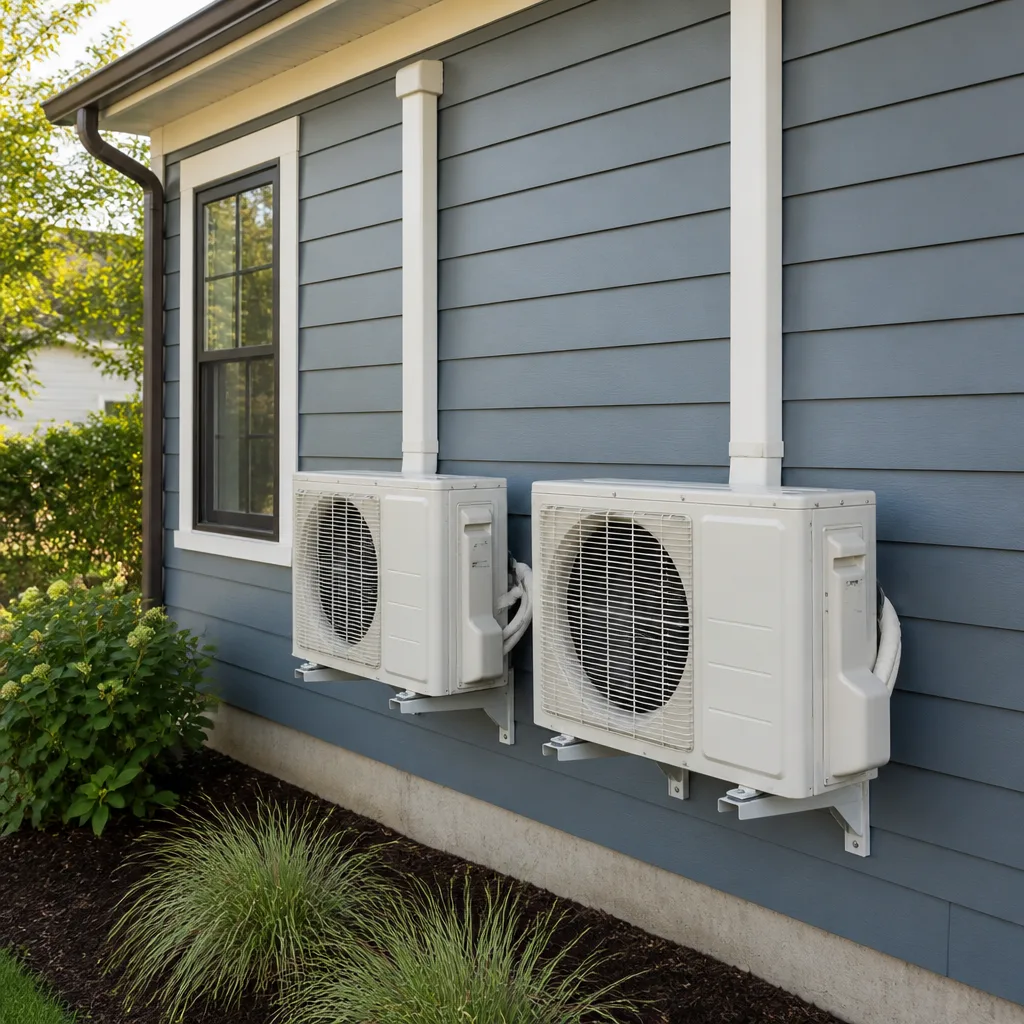 Ductless mini splits
 Carrier
 Trane
 Goodman
Seasonal tune-up and full diagnostic on your Carrier, Trane, or Goodman system - readings shown to you before any repair is proposed
Diagnosis first, numbers second - you approve the repair price before a single part goes in.
Get your free estimateAC Repair Maintenance Checklist for Henderson Homeowners
The call that strands the most Henderson homeowners in triple-digit weather isn’t a dead compressor or a refrigerant leak. It’s a clogged condensate drain line that trips a float switch and shuts the whole system down. The fix takes four minutes of attention and costs under $80 to prevent. Meanwhile, the failures that actually destroy compressors – cooked capacitors, dust-clogged coils, pitted contactors – build quietly for months before they show up on the hottest day of July. What follows is a checklist built around the failure points Henderson’s heat actually creates, ranked by how often they strand people, timed to the months when each task pays off most, and paired with the measurements a real tune-up has to include to prove it happened.
Quick Answer
Henderson homeowners should check and flush the condensate drain monthly from May through September, test the run capacitor once each spring, and book a full tune-up in March or April before the first heat wave. The tasks that prevent the most emergency calls are drain clearing, capacitor testing, and coil cleaning after dust storm season – all things a homeowner can either do or have inspected for a modest cost.
Styles & brands we work with
- AC repair
- Furnace & heating
- Heat pumps
- Ductless mini splits
- Carrier
- Trane
- Goodman
Table of Contents
- The Four Failures That Strand Henderson Homeowners, Ranked
- Henderson’s Maintenance Calendar: What to Do Each Month
- How to Test a Dual-Run Capacitor Before It Fails
- What a Real Tune-Up Measures (and What a Cheap One Skips)
- The Four-Minute Condensate Drain Routine
- Coil Fouling and the Dust Storm Problem
- What to Photograph After Every Service Visit
- What AC Maintenance Costs in Henderson
The Four Failures That Strand Henderson Homeowners, Ranked
Every climate produces its own pattern of breakdowns. In humid climates, it’s mold and rust. In Henderson, the pattern is driven by dry heat, wind-blown dust, and long runtimes – an AC here can run 3,000 hours a year, roughly triple what a system in a mild climate sees. That runtime accelerates wear on specific parts while leaving others relatively untouched. Here’s the order we see failures in, most common first.
- Clogged condensate drain line. The single most common no-cool call in Henderson. Dry air means heavy condensate production when the system first kicks on, and dust carried into the pan turns into a sludge that blocks the drain. The float switch trips, the system shuts off, and the house starts heating up at 2 p.m. in August.
- Failed run capacitor. The capacitor gives the compressor and fan motor the jolt they need to start. Henderson heat degrades capacitors faster than cool climates – a part rated for 60,000 hours can fail in four or five summers here. The symptom is a system that hums but doesn’t start, or starts only sometimes.
- Coil fouling from dust storms. The evaporator coil and outdoor condenser coil both collect the fine dust that blows through the valley in spring and early summer. A layer of dust just a sixteenth of an inch thick can cut efficiency by 15 percent and force the compressor to work harder, which shortens its life.
- Contactor pitting. The contactor is the switch that engages the compressor. Every start-and-stop cycle arcs a tiny bit of metal off the contacts, and Henderson’s long runtimes mean more cycles. Pitted contacts cause intermittent failures – the system runs fine for a week, then won’t start for an hour, then runs again.
Notice what’s not on this list: refrigerant leaks and compressor failure. Both happen, but they’re far less common than the four above, and all four are preventable with routine attention. If a system can’t keep up this summer and the cause isn’t obvious, AC repair in Henderson is worth a call before the problem cascades.
Henderson’s Maintenance Calendar: What to Do Each Month
Most checklists tell you to service the AC “before summer.” That’s too vague for a climate where the first 100-degree day can arrive in May and the last one can hang on into October. Here’s the schedule we recommend for Henderson specifically, with the reasoning behind each month.
- February to early March: Book the full tune-up. Technicians are still slow, scheduling is open, and you’ll beat the April rush. This is where you get the detailed measurements (more on that below).
- Late March: Test the capacitor. Doing it now means you have time to replace a weak one before the first heat wave, rather than discovering it at 4 p.m. on a 108-degree day.
- April: Clean the outdoor condenser coil. Dust season peaks in spring, and the coil is already loading up. Clean it before it clogs, not after.
- May through September: Flush the condensate drain every two to four weeks. In our experience, this is the task homeowners skip and then pay for.
- June: Replace the air filter. If you haven’t checked it since spring, it’s overdue. Henderson’s dust loads filters faster than most climates.
- July and August: Watch for symptoms – short cycling, weak airflow, warm air at the registers. These are early warnings, not normal operation.
- September to October: Post-season inspection. This is when a technician can catch wear from the summer before it becomes a failure next spring.
- November through January: The heating side gets the attention. If you have a furnace or heat pump, its own tune-up belongs here. Furnace repair in Henderson calls spike in December, and a fall checkup is far cheaper than an emergency visit.
The calendar isn’t fixed in stone. It’s a rhythm. The value is doing the right task at the right moment, when the cost is low and the failure hasn’t started yet.
How to Test a Dual-Run Capacitor Before It Fails
This is the one diagnostic a Henderson homeowner can reasonably do themselves, and it’s the one that most often prevents an emergency call. The dual-run capacitor is a small cylindrical part inside the outdoor unit that serves both the compressor and the condenser fan. When it fails, the system either won’t start or the fan won’t spin. Testing it takes ten minutes and a $30 multimeter.
Safety first. Capacitors hold a charge even after the power is off, and touching the terminals can deliver a painful shock. Before you touch anything: shut off the breaker at the panel, then wait at least five minutes for the capacitor to discharge. If you’re not comfortable working around stored electrical charge, don’t – this is a job for a technician, and we treat it as one.
- Switch off the AC at the thermostat and at the breaker panel.
- Wait five minutes, then remove the outdoor unit’s access panel with a screwdriver.
- Locate the capacitor – a metal cylinder roughly the size of a soda can, with three or four spade terminals on top.
- Set the multimeter to capacitance mode (µF).
- Discharge the capacitor by bridging the terminals with an insulated screwdriver. You may see a small spark; this is normal.
- Read the capacitance across the HERM and C terminals (compressor side), and across FAN and C (fan side).
- Compare the reading to the rating printed on the capacitor’s side. A reading more than 10 percent below the rated value means it’s failing and should be replaced.
If the reading is within tolerance, the capacitor is fine. If it’s low, replace it before summer – a capacitor that’s marginal in April will fail in July. A technician can also do this test during a tune-up, and it takes less than two minutes in trained hands.
What a Real Tune-Up Measures (and What a Cheap One Skips)
There’s a difference between a $59 “maintenance visit” and a real tune-up, and in Henderson it matters more than most places because the summer runtime is so punishing. A cheap visit is often just a filter change, a visual glance, and an invoice. A real tune-up involves measurements – numbers a technician records, not impressions they describe.
Here’s what to ask for, and what a proper service record should include:
- Superheat and subcooling readings. These tell you whether the refrigerant charge is correct. If a technician doesn’t take them, they can’t tell you the system’s efficiency.
- Temperature split between return and supply air. Normally 15 to 20 degrees. A lower number means a problem: low refrigerant, dirty coil, or duct leakage.
- Capacitor microfarad readings, compared to the rating on the part label.
- Static pressure across the air handler. High static pressure means restricted airflow, which is common with undersized or clogged filters and can cause freeze-ups in a Henderson summer.
- Amperage draw on the compressor and fan motor, measured against the nameplate rating.
- Coil condition, recorded as a number (dirty, moderately soiled, or clean) rather than a paragraph.
- Drain pan and drain line flow test, with a note on whether water drains freely.
- Contactor and relay inspection, with photos of any pitting.
A tune-up without these measurements is a filter change with a receipt. When you book, ask directly what will be measured and whether the numbers will be in the written report. That’s the difference between documentation and a rumor.
The Four-Minute Condensate Drain Routine
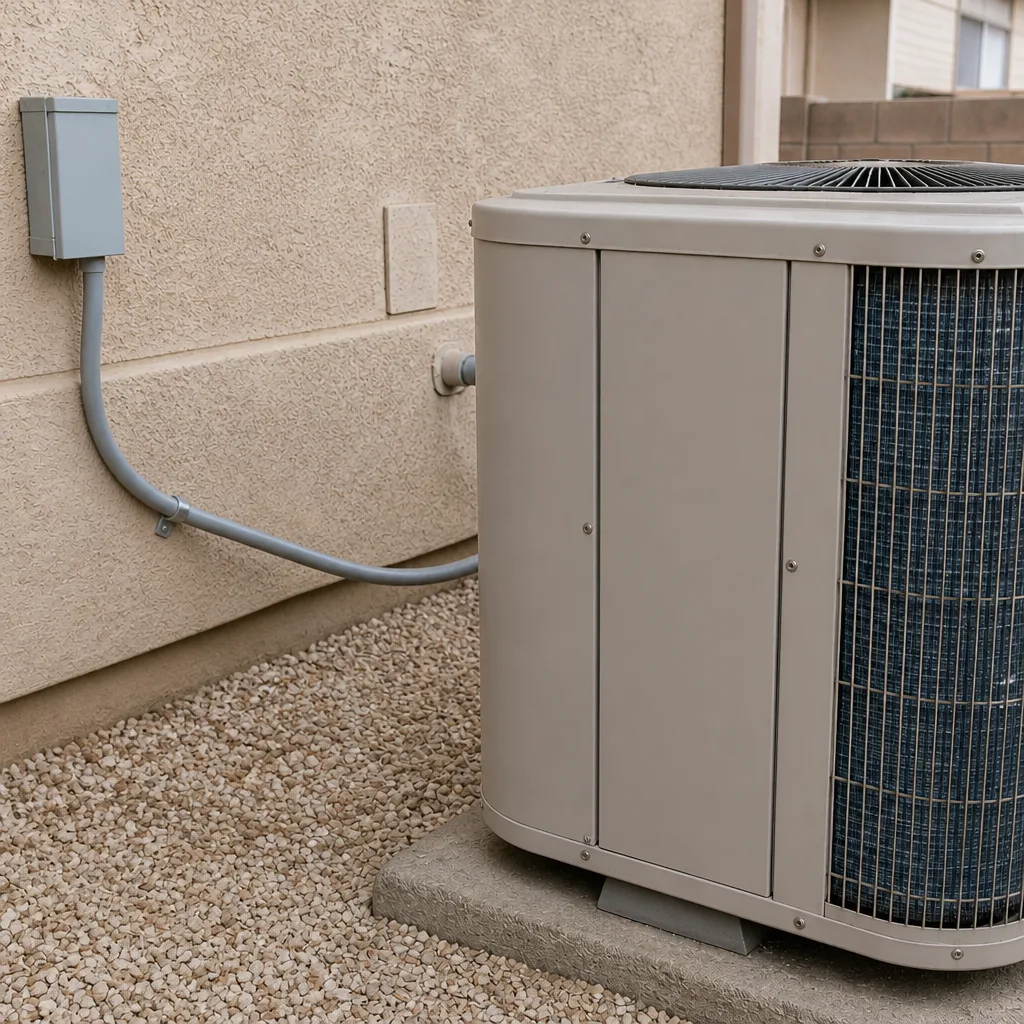
The condensate drain carries the water your AC pulls from the air. In most houses it runs from the indoor unit, through a PVC line, to a floor drain or outside the house. In Henderson, the line clogs more often than in humid climates because dry air forces the system to work harder, and dust drawn in with the return air settles in the drain pan and turns into a sludgy film.
Once the line blocks, water backs up into the pan, the float switch (a safety device) trips, and the system shuts off. That’s the 2 p.m. August no-cool call. Four minutes of routine work makes it rare.
- Find the drain line, usually near the indoor air handler or in the attic or closet where the unit sits.
- Look for the drain pan under the unit – if there’s standing water, the line is already blocked.
- Locate the cleanout tee or cap on the drain line, often a small threaded cap or a PVC tee with a removable plug.
- With the system running (the fan only), pour a cup of distilled white vinegar down the line through the tee, then flush with a quart of water.
- Check that water drains freely from the line’s endpoint – the point where it exits the house or drops into a floor drain.
- Repeat every two weeks through the summer months, or at least once a month.
- If water won’t drain, don’t force it. Call a technician – a blocked line can be cleared with a short blast of low-pressure air, but a homeowner using a shop vacuum or a drain snake can crack the PVC.
It pays to check the float switch works at the same time. Most have a small test button or a float you can lift gently to confirm it activates the shutoff. If it doesn’t trip, the switch needs replacement.
Coil Fouling and the Dust Storm Problem
Henderson’s spring and early summer dust storms do more damage to air conditioners than the heat itself. The fine, powdery dust that blows through the valley coats the outdoor condenser coil, and once it’s caked on, no amount of homeowner hose work will clean it – the fins are too close together. The dust also finds its way inside and settles on the indoor evaporator coil, where it mixes with condensation and forms a paste that restricts airflow.
The signs of coil fouling are easy to miss at first. The system takes longer to cool the house. The outdoor fan runs constantly. The electric bill creeps up. By the time the system is short-cycling, the coil may need a chemical cleaning, which is a technician’s job.
Prevention is straightforward: clean the outdoor coil with a garden hose (not a pressure washer, which bends fins) after each significant dust event, and change the indoor filter more often in spring and summer. In Henderson, we often recommend a filter check every 30 days from May through September, and replacement as needed rather than on a fixed schedule, because the dust load varies so much.
If you’re not sure the coil is clean, a technician can check it during a tune-up and tell you whether a full cleaning is needed. For a system that’s already struggling, proper cleaning often restores cooling capacity before anything else is replaced.
What to Photograph After Every Service Visit
Most Henderson homeowners get a service invoice and file it in a drawer. What they don’t realize is that a proper record of each visit can protect a warranty claim, support a home sale, and prevent a dispute over whether a repair was done. Here’s what to photograph and record after each visit.
- The invoice, showing the written price before work began. If the price changed mid-job, the original and the final invoice should both be recorded.
- Any written guarantee or warranty paperwork. At Coldharbour, that’s the 365-Day Done Right Promise, which we put in writing on every repair – if it fails within a year, we come back and fix it at no charge.
- Photographs of the system before and after the work, especially if the technician cleaned a coil, replaced a capacitor, or repaired the drain.
- The tune-up measurements, including superheat, subcooling, and temperature split. These are the proof the system was actually serviced, not just visited.
- Parts numbers and model numbers of anything replaced, along with the brand (Carrier, Trane, Lennox, American Standard, or others).
- The technician’s name and the date of the visit. Not for fault-finding, but for continuity – most companies keep records, but you should have your own copy.
This documentation habit pays off in three places: at warranty time, at resale, and if you ever need to compare two repair estimates. A home inspector can read a service record and see what was done and when. A buyer can see the system was maintained. And if a repair fails, you have the invoice that names the work and the guarantee that covers it.
What AC Maintenance Costs in Henderson
Maintenance costs in Henderson are modest compared to what a failed repair runs. A full tune-up typically costs between $120 and $250, depending on the system type and the extent of the measurements. A capacitor replacement runs $180 to $320, parts and labor included. A drain line clearing is usually $100 to $180, and a full coil cleaning runs $200 to $450 depending on the coil’s condition.
- Spring tune-up: $120 – $250, with superheat, subcooling, and temperature-split readings documented.
- Capacitor replacement: $180 – $320, including the test and the part.
- Condensate drain clearing: $100 – $180.
- Coil cleaning (outdoor condenser): $150 – $300.
- Coil cleaning (indoor evaporator): $200 – $450, depending on accessibility.
- Contactor replacement: $150 – $280.
These ranges reflect what we see in the Henderson market. If a quote comes in dramatically lower, ask what’s included – often it’s a filter change and a visual check, not a tune-up. The written price should be handed to you before any work starts, and that’s a standard we hold to on every job.
For a system that’s more than 12 to 15 years old and needs multiple repairs, replacement is often the better value. Our guide to AC installation in Henderson covers the sizing, rebate, and scheduling side of that decision.
Common Mistakes to Avoid
- Waiting until the first 100-degree day to call. By then, every HVAC company in Henderson is booked, and a tune-up becomes an emergency repair. Book in February or March.
- Skipping the condensate drain because it looks fine. The line clogs from the inside, where you can’t see it. Flushing it monthly is the cheapest insurance on the whole system.
- Assuming a cheap “maintenance visit” includes measurements. A $59 visit that doesn’t record superheat, subcooling, and capacitance numbers isn’t a tune-up. It’s a filter change.
- Ignoring dust-storm coil cleaning. Dust cake on the condenser is the leading cause of summer efficiency loss in Henderson, and it’s preventable with a garden hose.
- Never testing the capacitor. A failing capacitor is the second most common cause of no-cool calls here, and a multimeter test in March catches it before July.
- Throwing away the written guarantee. Every serious repair should come with a written guarantee. If the company won’t put it on paper, that’s a reason to call someone else.
- Filter neglect in spring. Henderson’s dust season loads filters faster than the “change every three months” advice assumes. Check monthly from May through September.
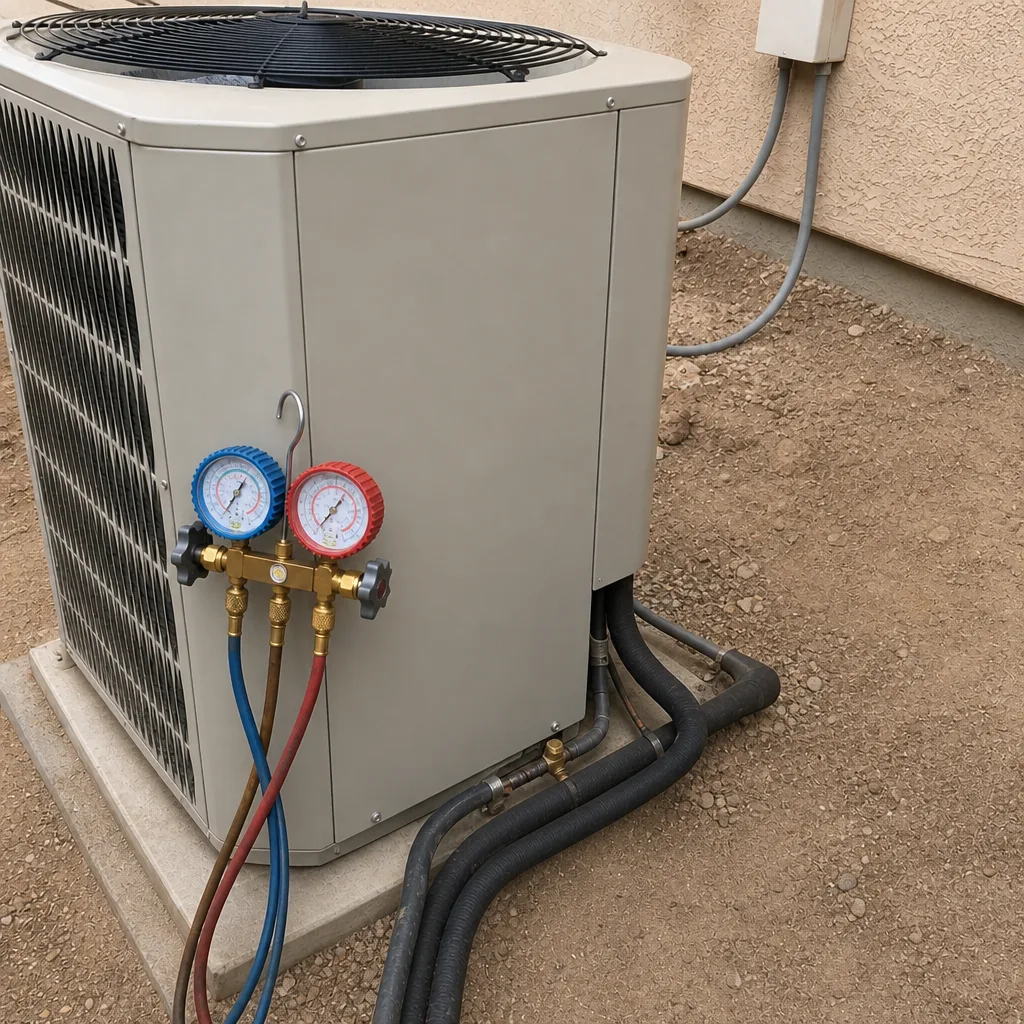
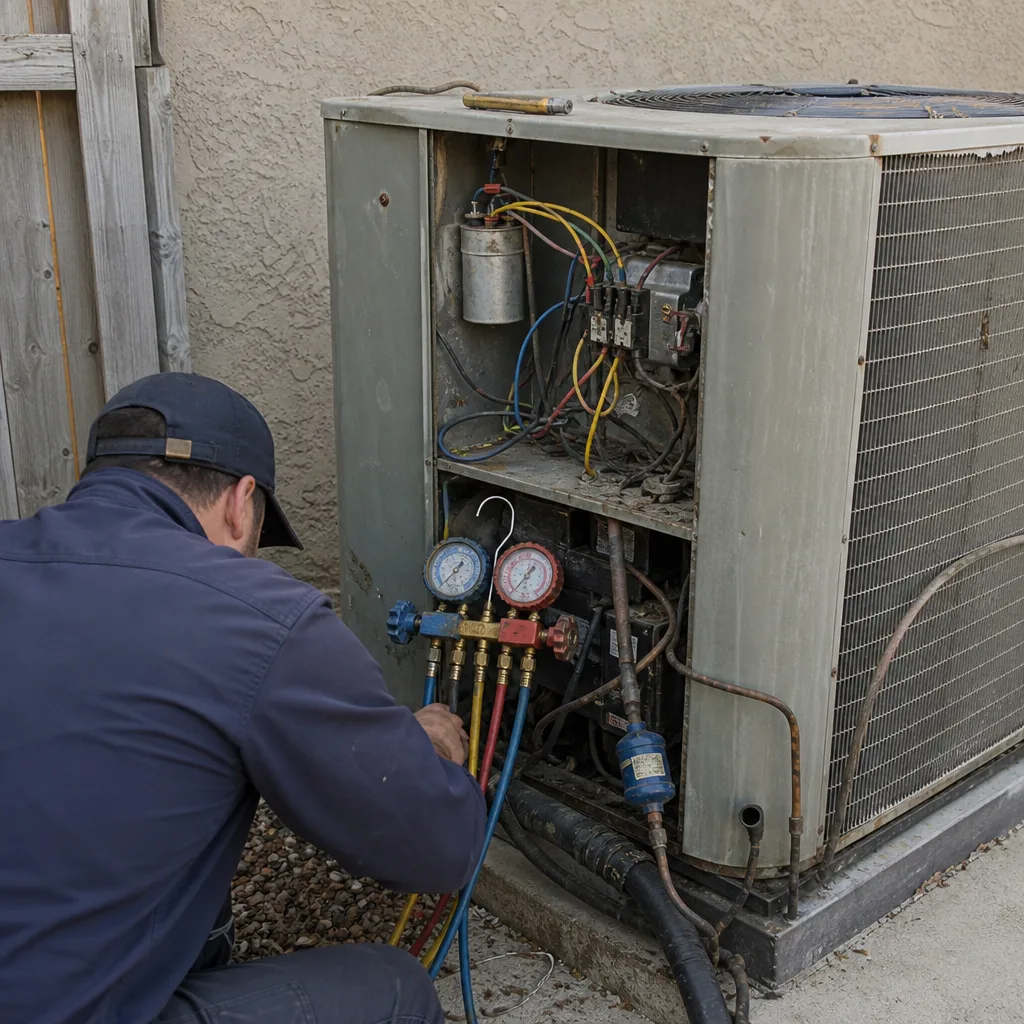
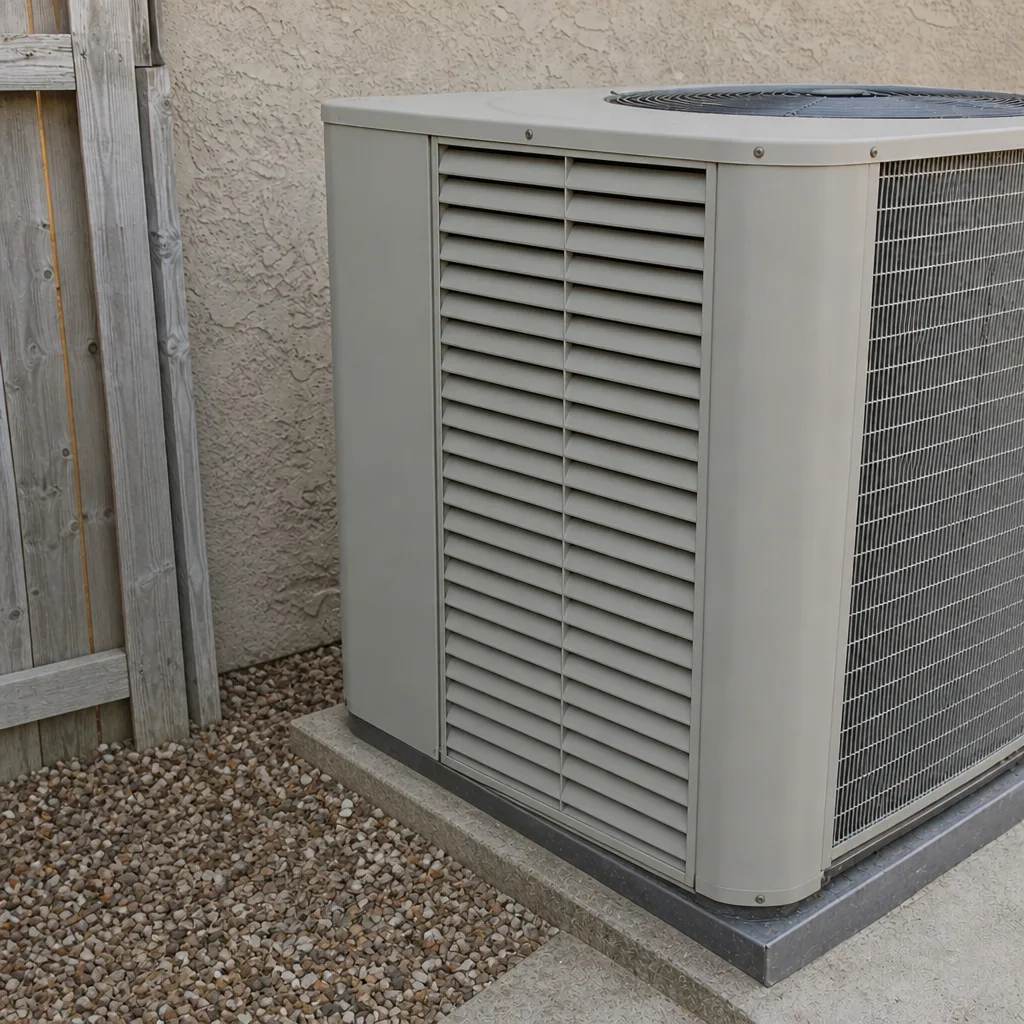
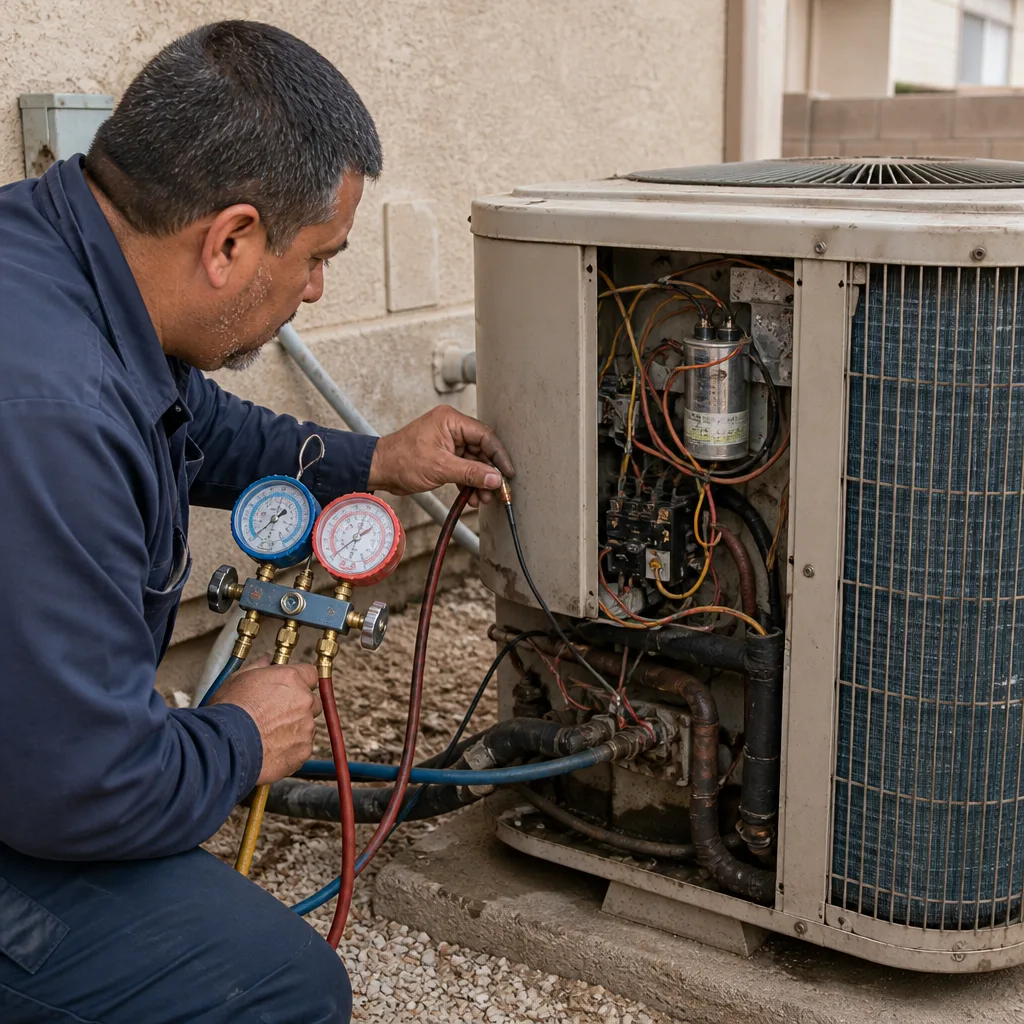
See the difference
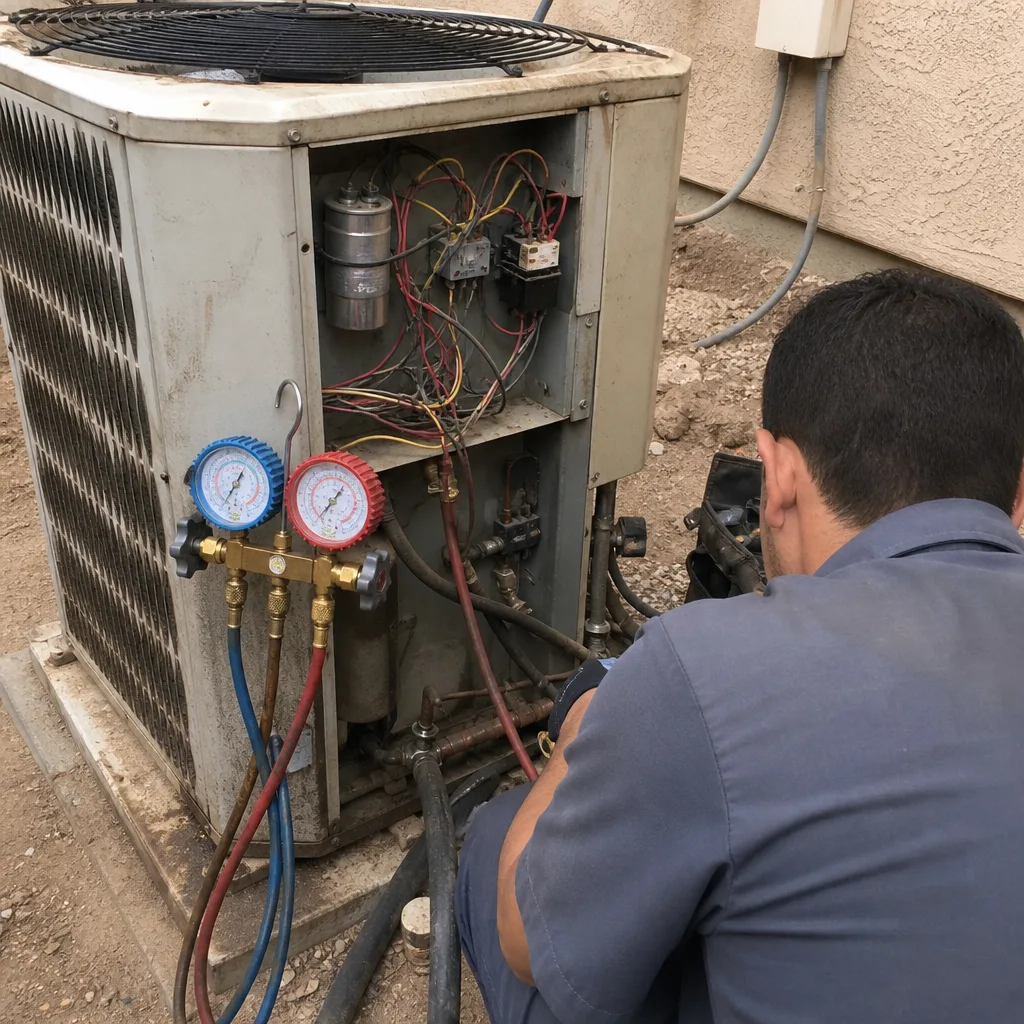 Before
 After
 Before
 After
 Before
 After
When to Call a Professional
Some tasks on this checklist are homeowner work, and some aren’t. Call a professional when the capacitor test or drain clearing is more than you want to take on, or when you see any of these:
- The system hums but doesn’t start, or starts only intermittently.
- Ice forms on the indoor coil or the refrigerant line.
- The float switch trips and keeps tripping after the drain is flushed.
- The breaker trips when the AC starts.
- Water is standing in the drain pan after a flush.
- The house won’t cool below 80 degrees on a normal summer day.
- The electric bill jumps without explanation.
Coldharbour Heating & Air Henderson offers free estimates in Henderson – call (844) 797-5122. Our technicians have up to 23 years of experience and are trained to service all major brands, including Carrier, Trane, Lennox, and American Standard. Every repair comes with a written price before work begins and our 365-Day Done Right Promise: if the repair fails within a year, we return and correct it at no charge. Phones are answered by a live person 24 hours a day, every day.
Frequently Asked Questions
Once a year in spring, ideally February through early April before the rush, plus monthly drain checks through the summer. Systems that run almost year-round may benefit from a second inspection in the fall. Booking early is the difference between a scheduled tune-up and an emergency repair.
A clogged condensate drain line that trips the float switch. It’s more common here than refrigerant leaks or compressor failures, and it’s preventable with a monthly flush that takes four minutes. Dry heat and dust combine to form sludge that blocks the line faster than in humid climates, so it’s worth making it part of your routine.
Yes, with a multimeter that reads capacitance, if you’re comfortable working around stored electrical charge. Power off at the breaker, wait five minutes, and discharge the capacitor before testing. If you’re not comfortable, a technician can do it during a tune-up in about two minutes – it’s a quick check that can prevent a mid-summer shutdown.
Most tune-ups run $120 to $250, depending on the system and what’s included. A proper tune-up should record superheat, subcooling, temperature split, and capacitor readings, and provide a written report. If a quote is much lower, ask exactly what’s being measured – a filter change isn’t a tune-up.
Spring and early summer dust storms blow fine dust across the valley, and the outdoor condenser coil catches it. The fins are too close together for the dust to shed on its own. Rinsing the coil with a garden hose after a dust event, plus regular filter changes, keeps fouling under control and protects efficiency.
If the system is 12 to 15 years old and needs a capacitor, a coil cleaning, and a contactor in the same season, replacement is usually the better value. A single repair on an otherwise healthy system is worth doing. Our guide to AC installation in Henderson covers sizing and rebates for the replacement path.
The Bottom Line
Henderson’s heat creates a specific pattern of AC failures, and the checklist that prevents them is different from the generic one most homeowners find online. Ranked by frequency, the four to watch are clogged condensate drains, failing capacitors, dust-fouled coils, and pitted contactors – all preventable with attention timed to the right month. A real tune-up includes measurements, not just a filter change. The written guarantee matters. And a four-minute drain flush in July is worth more than any emergency repair in August.
If you’d like a free estimate or a tune-up scheduled before the heat arrives, call (844) 797-5122 – a live person answers, day or night. You can also start at the Coldharbour Heating & Air Henderson home page to see what else we cover.
Written by the team at Coldharbour Heating & Air Henderson.